
Cabot conducts its business with integrity, transparency, reliability and objectivity, with a view to establishing a foundation of trust on which sustainable, long-term relationships can be built.
Our Founding Principles
Businesses must deliver financial returns sufficiently attractive to secure capital needed to support operations and growth into the long-term. Investors need to allocate capital in line with values and targeted risk-adjusted returns. Businesses and investors collectively can achieve financial aims whilst also addressing a variety of environmental and societal ecosystem challenges, now recognized as impacting long term value creation¹. Capital logically should flow to businesses that capture value across ecosystems.
By way of example, for decades, science, research and practice have signaled ongoing degradation of natural systems attributable to anthropogenic activities and behaviours – with the now foreseeable prospect of irreversible damage to natural ecosystems and the breakdown of societal cohesion in the absence of improving the nature and ways of doing business. Understanding interlinkages between capital, social and natural ecosystems using systems thinking approaches is steadily steering financing towards enterprises executing improvements. However, the broad-based transformative shift required to restore a balance enabling nature, people and economies to thrive into the long-term continues as a work in progress.
Ecosystem impacts are multi-dimensional, perhaps the most easily understood impact relates to the attribution of greenhouse gas emissions from human activities to elevated global temperatures (human induced climate change or “global warming”)². The consequences of global warming are manifesting in increasingly frequent and severe extreme weather events – heatwaves, droughts, glacial melts, floods – and consequential economic and livelihood losses, food insecurity, health and welfare challenges et al. Asia, as other regions, continues annually to experience negative impacts from climate change – recurrent extreme heat undermines the integrity of the built environment, emissions ramp up as traditional cooling technology usage rises, crop yields reduce, health, life-style and life expectancy all suffer from heat intolerance; floods accelerate already dwindling potable water supplies where barriers between industrial discharge, agricultural run-off and other human effluent are compromised. In this context, resilient businesses are those seeking to address and mitigate climate change and/or facilitate adaptation and understand the risks and opportunities
Suggested Reading:
¹ World Economic Forum, Winning in Green Markets: Scaling Products for a Net Zero World
NYU Stern CSB, Sustainability-Linked Value Creation Guide for Private Equity Limited Partners
Bain & EcoVadis, Do ESG Efforts Create Value
S&P Global, For the world’s largest companies, climate physical risks have a $1.2 trillion annual price tag by the 2050s
² Carbon Tracker, Absolute Impact-2026
Reference Frameworks
Traditional reference methodologies which may include:
- Global/regional/national best in class regulation, guidelines & taxonomies
- Industry/sector best practice and bellwethers
- UNSDG, SBTI, and other frameworks guiding sustainable growth
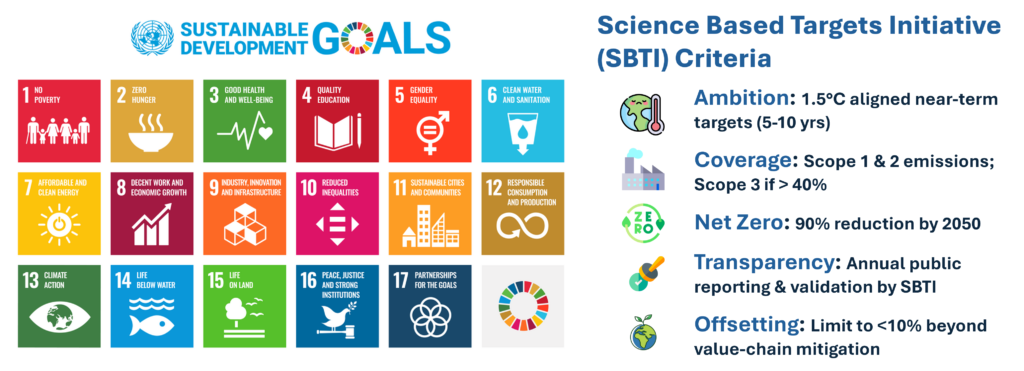
Key Reference Reports:
UN Sustainable Development Goals 2025 | SBTI Trend Tracker | UNCTAD SDG Pulse 2025 | Planetary Health Check 2025 | Greenhouse Gas Protocol | Global Water Bankruptcy 2026